Why Will a Buyer Pay Less Than My Business Is Worth?
Exit / Sale
Exit / Sale
/
/
TEP
TEP

Your business is worth less to a buyer than it is to you.
These two foundations are almost always the reason — and neither of them is on most founders' priority lists.
Every founder believes their business is worth more than the market will pay. Most of the time, they are right.
The gap is real. The business does have more value than the current structure allows a buyer to pay for. The problem is not in the buyer's valuation. It is in the structure of the business.
And almost always, the gap is not in the EBITDA. It is in the multiple.
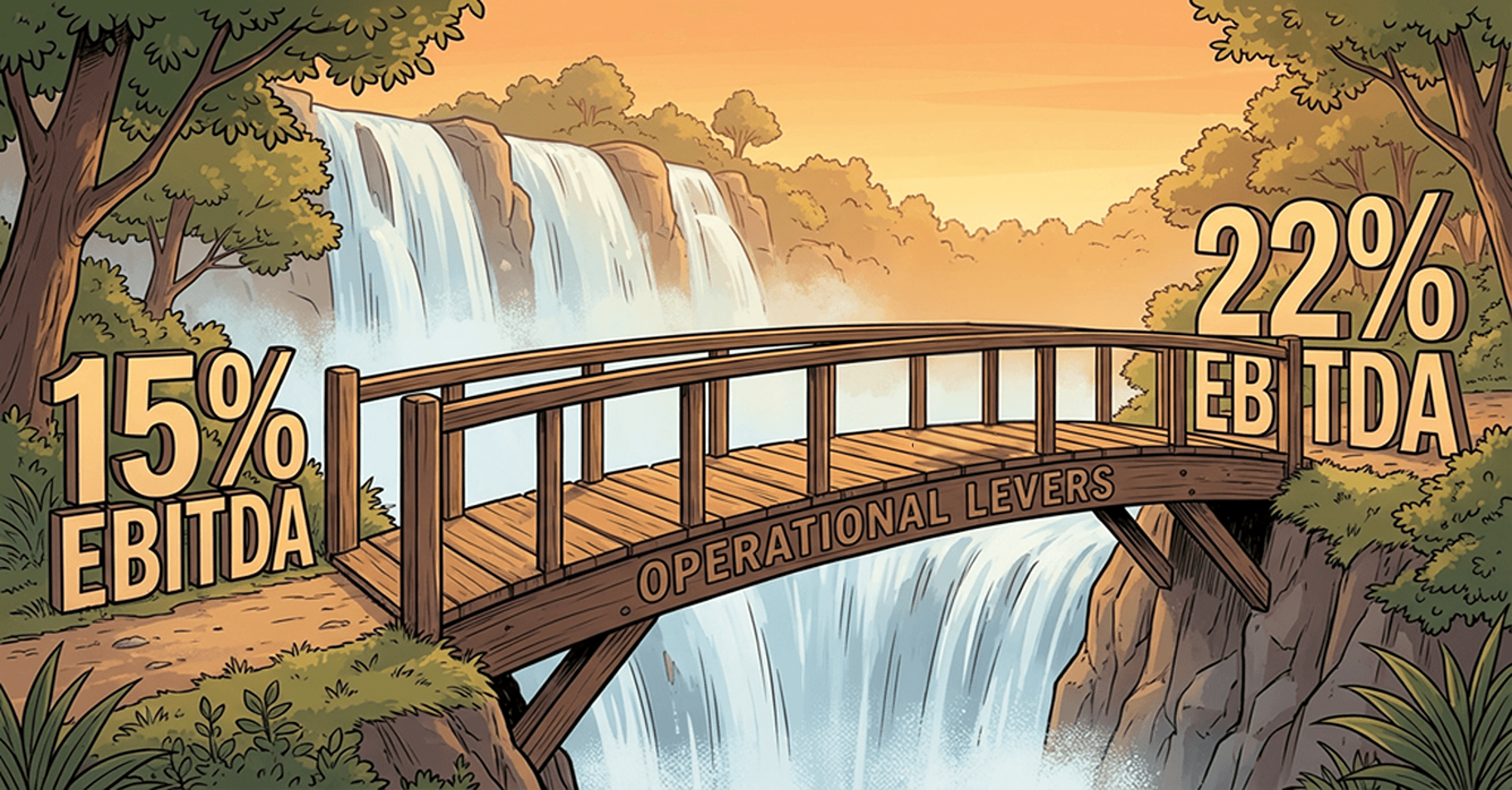
A business with £2M EBITDA at a 5× multiple is worth £10M. The same business, same EBITDA, structured to trade at 8×, is worth £16M. That £6M difference is the valuation gap. It does not require a single pound of operational improvement. It requires structural change in Foundations 1 and 2.
This is the intervention most founders never make — not because they cannot see the value in it, but because it is harder to see than a revenue target or an operational metric. It requires working on the business in a way that does not show up in monthly results. And it requires starting two years before the process begins.
What determines the multiple
Buyers do not pay a multiple of EBITDA. They pay a multiple of the risk-adjusted EBITDA they expect to generate after acquiring the business. The multiple reflects their confidence that the earnings will continue, grow, and be realised without the current owner.
Every factor that reduces that confidence reduces the multiple.
The two factors that reduce buyer confidence most consistently are founder dependency and key person risk. Both trace to Foundations 1 and 2.
Leadership and strategy — the primary multiple driver
Founder dependency is the single biggest multiple suppressor in a £5M–£100M business. If the strategy lives in the founder's head — if key decisions are made by one person, if client relationships are held by one person, if the business works differently when that person is not present — a buyer is not acquiring a business. They are acquiring a person. And people are not transferable.
Buyers price this risk by reducing the multiple they will pay. They may also structure part of the consideration as an earnout — paying the full price only if the founder remains and the business continues to perform. Both are symptoms of the same valuation gap.
The fix is not to remove the founder. It is to build a leadership architecture that holds the business independently of any one person. Strategic clarity the leadership team can execute without escalating. Decision rights distributed to the level where decisions should be made. A business that demonstrably operates to the same standard whether the founder is present or not.
The moment a buyer realises the business runs because of one person, the multiple moves. And it does not move back.
People and talent — the key person risk premium
Key person risk is closely related to founder dependency but distinct from it. It describes the concentration of critical commercial or operational knowledge in a small number of individuals who may or may not be the founder.
A business where three client relationships — representing 60% of revenue — are held by one senior person who could leave post-acquisition carries significant key person risk. A business where the operational knowledge required to deliver consistently resides in two people who have been there for fifteen years carries the same risk. In both cases, a buyer is acquiring capability that may not survive the transaction.
The fix is to distribute knowledge, relationship, and capability across the leadership and management team. To build a People and Talent foundation where the business performs consistently regardless of who is present on any given day.
The compounding effect of closing the valuation gap
Fixing the multiple gap is the highest-return intervention available to a business preparing for exit. Every pound of EBITDA improvement is multiplied by the multiple. If the multiple is suppressed, every operational improvement is worth less than it should be.
Fix the multiple from 5× to 7× on £2M EBITDA: business value increases by £4M without changing a single operational metric
Close the EBITDA gap from £2M to £2.5M: at 7× that additional £500K of EBITDA is worth £3.5M
Combined effect: multiple expansion and EBITDA improvement together deliver significantly more than either in isolation
The valuation gap must be addressed before, or at the same time as, the EBITDA and revenue gaps. It is the multiplier on everything else. Fix it last and every other improvement is worth less than it should be.
The businesses that sell for what they are worth are the ones that addressed the valuation gap first — not because it was the most urgent problem in the business, but because it is the one that multiplies the value of every other improvement made in the 24 months before sale.
The valuation gap is a structural problem, not a financial one. It closes when the business can demonstrate it operates independently of its founder — with evidence, not intention.
Take the Optimiser — seven minutes to understand how leadership dependency and key person risk are suppressing your valuation multiple. theexecutivepartnership.com/optimiser
The Executive Partnership · Built to Scale. Ready to Sell.
Your business is worth less to a buyer than it is to you.
These two foundations are almost always the reason — and neither of them is on most founders' priority lists.
Every founder believes their business is worth more than the market will pay. Most of the time, they are right.
The gap is real. The business does have more value than the current structure allows a buyer to pay for. The problem is not in the buyer's valuation. It is in the structure of the business.
And almost always, the gap is not in the EBITDA. It is in the multiple.
A business with £2M EBITDA at a 5× multiple is worth £10M. The same business, same EBITDA, structured to trade at 8×, is worth £16M. That £6M difference is the valuation gap. It does not require a single pound of operational improvement. It requires structural change in Foundations 1 and 2.
This is the intervention most founders never make — not because they cannot see the value in it, but because it is harder to see than a revenue target or an operational metric. It requires working on the business in a way that does not show up in monthly results. And it requires starting two years before the process begins.
What determines the multiple
Buyers do not pay a multiple of EBITDA. They pay a multiple of the risk-adjusted EBITDA they expect to generate after acquiring the business. The multiple reflects their confidence that the earnings will continue, grow, and be realised without the current owner.
Every factor that reduces that confidence reduces the multiple.
The two factors that reduce buyer confidence most consistently are founder dependency and key person risk. Both trace to Foundations 1 and 2.
Leadership and strategy — the primary multiple driver
Founder dependency is the single biggest multiple suppressor in a £5M–£100M business. If the strategy lives in the founder's head — if key decisions are made by one person, if client relationships are held by one person, if the business works differently when that person is not present — a buyer is not acquiring a business. They are acquiring a person. And people are not transferable.
Buyers price this risk by reducing the multiple they will pay. They may also structure part of the consideration as an earnout — paying the full price only if the founder remains and the business continues to perform. Both are symptoms of the same valuation gap.
The fix is not to remove the founder. It is to build a leadership architecture that holds the business independently of any one person. Strategic clarity the leadership team can execute without escalating. Decision rights distributed to the level where decisions should be made. A business that demonstrably operates to the same standard whether the founder is present or not.
The moment a buyer realises the business runs because of one person, the multiple moves. And it does not move back.
People and talent — the key person risk premium
Key person risk is closely related to founder dependency but distinct from it. It describes the concentration of critical commercial or operational knowledge in a small number of individuals who may or may not be the founder.
A business where three client relationships — representing 60% of revenue — are held by one senior person who could leave post-acquisition carries significant key person risk. A business where the operational knowledge required to deliver consistently resides in two people who have been there for fifteen years carries the same risk. In both cases, a buyer is acquiring capability that may not survive the transaction.
The fix is to distribute knowledge, relationship, and capability across the leadership and management team. To build a People and Talent foundation where the business performs consistently regardless of who is present on any given day.
The compounding effect of closing the valuation gap
Fixing the multiple gap is the highest-return intervention available to a business preparing for exit. Every pound of EBITDA improvement is multiplied by the multiple. If the multiple is suppressed, every operational improvement is worth less than it should be.
Fix the multiple from 5× to 7× on £2M EBITDA: business value increases by £4M without changing a single operational metric
Close the EBITDA gap from £2M to £2.5M: at 7× that additional £500K of EBITDA is worth £3.5M
Combined effect: multiple expansion and EBITDA improvement together deliver significantly more than either in isolation
The valuation gap must be addressed before, or at the same time as, the EBITDA and revenue gaps. It is the multiplier on everything else. Fix it last and every other improvement is worth less than it should be.
The businesses that sell for what they are worth are the ones that addressed the valuation gap first — not because it was the most urgent problem in the business, but because it is the one that multiplies the value of every other improvement made in the 24 months before sale.
The valuation gap is a structural problem, not a financial one. It closes when the business can demonstrate it operates independently of its founder — with evidence, not intention.
Take the Optimiser — seven minutes to understand how leadership dependency and key person risk are suppressing your valuation multiple. theexecutivepartnership.com/optimiser
The Executive Partnership · Built to Scale. Ready to Sell.

Exit / Sale
/
TEP
Exit / Sale
/
TEP
" height="39.65002px" id="dyBuTZHxn" transform="translate(0 1.907)" width="39.651px"/><path d="M 20.978 11.868 C 21.065 12.063 21.069 12.282 20.99 12.482 C 20.912 12.681 20.756 12.839 20.559 12.919 C 17.474 14.2 5.621 19.119 1.097 20.999 C 0.801 21.122 0.46 21.051 0.233 20.827 C 0.006 20.599 -0.062 20.257 0.06 19.962 C 1.932 15.436 6.835 3.575 8.112 0.491 C 8.193 0.291 8.352 0.134 8.55 0.054 C 8.749 -0.023 8.971 -0.018 9.167 0.068 C 14.398 2.447 18.596 6.639 20.978 11.868 Z" fill="rgb(243, 183, 3)" height="21.059159164719897px" id="j9USqGJeT" transform="translate(20.497 0)" width="21.04621552472423px"/></svg>)
The Executive
Partnership
Built to Scale. Ready to Sell.
The Executive Partnership Limited
Company No. 16340502 | Registered in England and Wales
Registered Office: Chandos House, School Lane, Buckingham, MK18 1HD, UK
The Executive
Partnership
Built to Scale. Ready to Sell.
The Executive Partnership Limited
Company No. 16340502 | Registered in England and Wales
Registered Office: Chandos House, School Lane, Buckingham, MK18 1HD, UK
The Executive Partnership
Built to Scale. Ready to Sell.
The Executive Partnership Limited
Company No. 16340502 | Registered in England and Wales
Registered Office: Chandos House, School Lane, Buckingham, MK18 1HD, UK