Why Is My Business Worth Less Than I Expected?
Exit / Sale
Exit / Sale
/
/
TEP
TEP

Most businesses that go to sale leave 30–50% of their value behind.
It is not created in the sale process. It is created in the years before it — and it closes in the 24 months before the process starts, not during it.
We have been in the room when founders are told what their business is worth.
The number is always lower than they expected. Sometimes dramatically lower. And the conversation that follows almost always goes the same way. The founder explains what the business has built. The buyer explains what they are prepared to pay for. The gap between those two things is the enterprise value gap — and by the time the founder is hearing about it in a sale process, it is too late to close it.
Most founders spend twenty years building a business and ninety days preparing to sell it. The decisions that determine the multiple have already been made — usually years earlier, usually without anyone realising it.
A business with £2M EBITDA selling at a 5× multiple is worth £10M. The same business, with the same EBITDA, structured correctly, might trade at 8×. That £6M difference is the enterprise value gap. And it closes in the 24 months before the process starts — not during it.
The exit sequence is different from the scaling sequence. Understanding the difference is the starting point for capturing the value that most businesses leave behind.
Why preparing for exit is different from scaling
In a scaling business, Finance and Legal sits at the bottom of the sequence — it is the output of getting the other five foundations right.
In an exit-focused business, Finance and Legal moves to the top. Not because the other foundations matter less — they matter more. But because you cannot design the intervention without knowing the gap. A business approaching sale needs to know its current valuation baseline, the quality of its EBITDA, and the multiple it would command today before it can identify which foundations to fix first.
The exit sequence runs in this order:
Start with the numbers — establish the valuation baseline, clean the financials, understand what a buyer will see
Then leadership — make the business independent of the founder
Then people — retention, succession, reducing key person dependency
Then operations — document everything, demonstrate the business can run without institutional knowledge
Then commercial — demonstrate a repeatable engine that does not depend on the founder
Finally technology — demonstrate scalable infrastructure, not a patchwork of manual workarounds
The three things a buyer prices before they look at your numbers
Every business approaching sale has three gaps that a buyer will price. Understanding which is largest tells you where to focus the 24 months before the process begins.
The multiple gap is the most valuable — and the most ignored.
A business trading at 5× when it should trade at 8× has a £6M gap on £2M EBITDA — before a single pound of operational improvement. This gap traces to Foundations 1 and 2 in every business. Founder dependency, key person risk, and leadership architecture that does not survive the owner's departure all suppress the multiple a buyer will pay.
The EBITDA gap is the most visible.
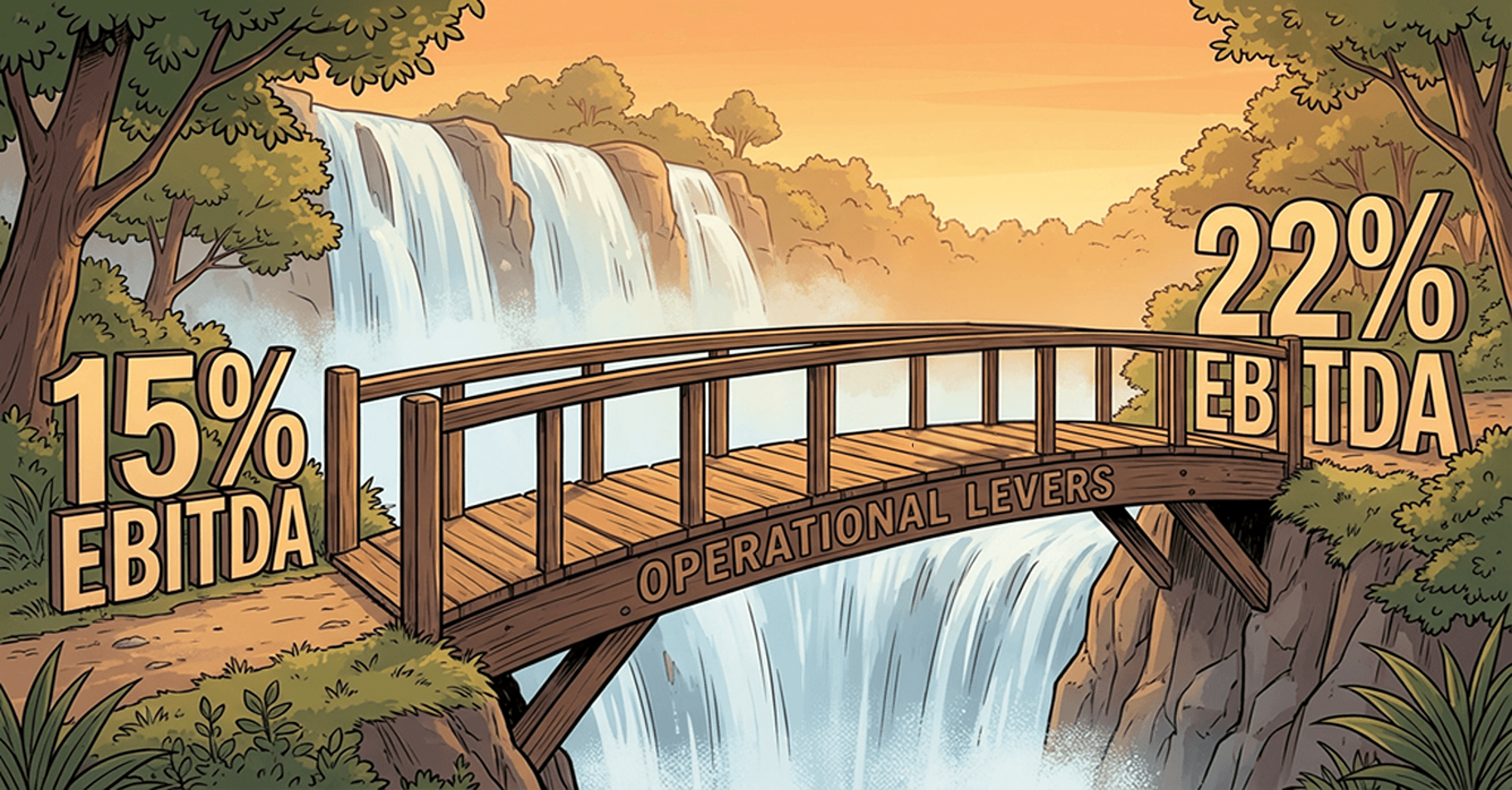
Revenue is there. Margin is not where it should be. This traces to Foundations 4 and 5 — operational inefficiency, manual processes, cost structures that do not scale. Every pound of EBITDA added in the 24 months before sale is multiplied by the exit multiple. The two compound.
The revenue gap is the least recoverable in a short exit timeline.
Revenue growth takes time. The more important focus in the 24 months before sale is demonstrating that the commercial engine is repeatable and not dependent on the founder or one or two key individuals.
What buyers actually pay for
Private equity and strategic buyers do not pay for revenue. They pay for EBITDA. They do not pay for EBITDA alone. They pay for EBITDA multiplied by the multiple they assign to the risk of running the business without you.
The most common buyer discount is founder dependency. A business where the key client relationships, the operational knowledge, and the strategic direction all sit with the founder is a business that loses value the moment the founder leaves. Buyers know this. They price it. Often by 20–40% of the multiple.
The multiple gap closes when the business can demonstrate it operates independently of the founder. Not in theory. In practice. With evidence from the 12 months before the sale process begins.
The 24-month exit timeline
Months 1–3: Establish the valuation baseline. Know what the business is worth today. Identify the EBITDA gap, the multiple gap, and the revenue quality issues a buyer would flag.
Months 3–12: Start with leadership. Make the strategic direction explicit and delegatable. Build the decision architecture that allows the leadership team to hold the business without the founder.
Months 6–18: Then the people question. Ensure the right people are in the right roles with the right authority. Put retention arrangements in place for the people a buyer needs to keep.
Months 12–24: Address Foundations 4 and 5. Document processes. Demonstrate operational consistency. Clean the technology stack. Show a buyer a business that runs without institutional knowledge walking out the door.
Throughout: Track the EBITDA impact of every intervention. Every operational improvement made in the right sequence adds to the EBITDA that will be multiplied by the exit multiple.
The businesses that sell for what they should be worth are the ones that planned the exit 24 months in advance. Not because they had more time. Because the interventions that close the enterprise value gap take time to embed and demonstrate.
A buyer will ask for 12–24 months of evidence that the business performs without the founder. That evidence cannot be manufactured in 90 days. It has to exist.
Take the Optimiser — seven minutes to quantify your enterprise value gap and identify which foundation is suppressing your exit multiple. theexecutivepartnership.com/optimiser
The Executive Partnership · Built to Scale. Ready to Sell.
Most businesses that go to sale leave 30–50% of their value behind.
It is not created in the sale process. It is created in the years before it — and it closes in the 24 months before the process starts, not during it.
We have been in the room when founders are told what their business is worth.
The number is always lower than they expected. Sometimes dramatically lower. And the conversation that follows almost always goes the same way. The founder explains what the business has built. The buyer explains what they are prepared to pay for. The gap between those two things is the enterprise value gap — and by the time the founder is hearing about it in a sale process, it is too late to close it.
Most founders spend twenty years building a business and ninety days preparing to sell it. The decisions that determine the multiple have already been made — usually years earlier, usually without anyone realising it.
A business with £2M EBITDA selling at a 5× multiple is worth £10M. The same business, with the same EBITDA, structured correctly, might trade at 8×. That £6M difference is the enterprise value gap. And it closes in the 24 months before the process starts — not during it.
The exit sequence is different from the scaling sequence. Understanding the difference is the starting point for capturing the value that most businesses leave behind.
Why preparing for exit is different from scaling
In a scaling business, Finance and Legal sits at the bottom of the sequence — it is the output of getting the other five foundations right.
In an exit-focused business, Finance and Legal moves to the top. Not because the other foundations matter less — they matter more. But because you cannot design the intervention without knowing the gap. A business approaching sale needs to know its current valuation baseline, the quality of its EBITDA, and the multiple it would command today before it can identify which foundations to fix first.
The exit sequence runs in this order:
Start with the numbers — establish the valuation baseline, clean the financials, understand what a buyer will see
Then leadership — make the business independent of the founder
Then people — retention, succession, reducing key person dependency
Then operations — document everything, demonstrate the business can run without institutional knowledge
Then commercial — demonstrate a repeatable engine that does not depend on the founder
Finally technology — demonstrate scalable infrastructure, not a patchwork of manual workarounds
The three things a buyer prices before they look at your numbers
Every business approaching sale has three gaps that a buyer will price. Understanding which is largest tells you where to focus the 24 months before the process begins.
The multiple gap is the most valuable — and the most ignored.
A business trading at 5× when it should trade at 8× has a £6M gap on £2M EBITDA — before a single pound of operational improvement. This gap traces to Foundations 1 and 2 in every business. Founder dependency, key person risk, and leadership architecture that does not survive the owner's departure all suppress the multiple a buyer will pay.
The EBITDA gap is the most visible.
Revenue is there. Margin is not where it should be. This traces to Foundations 4 and 5 — operational inefficiency, manual processes, cost structures that do not scale. Every pound of EBITDA added in the 24 months before sale is multiplied by the exit multiple. The two compound.
The revenue gap is the least recoverable in a short exit timeline.
Revenue growth takes time. The more important focus in the 24 months before sale is demonstrating that the commercial engine is repeatable and not dependent on the founder or one or two key individuals.
What buyers actually pay for
Private equity and strategic buyers do not pay for revenue. They pay for EBITDA. They do not pay for EBITDA alone. They pay for EBITDA multiplied by the multiple they assign to the risk of running the business without you.
The most common buyer discount is founder dependency. A business where the key client relationships, the operational knowledge, and the strategic direction all sit with the founder is a business that loses value the moment the founder leaves. Buyers know this. They price it. Often by 20–40% of the multiple.
The multiple gap closes when the business can demonstrate it operates independently of the founder. Not in theory. In practice. With evidence from the 12 months before the sale process begins.
The 24-month exit timeline
Months 1–3: Establish the valuation baseline. Know what the business is worth today. Identify the EBITDA gap, the multiple gap, and the revenue quality issues a buyer would flag.
Months 3–12: Start with leadership. Make the strategic direction explicit and delegatable. Build the decision architecture that allows the leadership team to hold the business without the founder.
Months 6–18: Then the people question. Ensure the right people are in the right roles with the right authority. Put retention arrangements in place for the people a buyer needs to keep.
Months 12–24: Address Foundations 4 and 5. Document processes. Demonstrate operational consistency. Clean the technology stack. Show a buyer a business that runs without institutional knowledge walking out the door.
Throughout: Track the EBITDA impact of every intervention. Every operational improvement made in the right sequence adds to the EBITDA that will be multiplied by the exit multiple.
The businesses that sell for what they should be worth are the ones that planned the exit 24 months in advance. Not because they had more time. Because the interventions that close the enterprise value gap take time to embed and demonstrate.
A buyer will ask for 12–24 months of evidence that the business performs without the founder. That evidence cannot be manufactured in 90 days. It has to exist.
Take the Optimiser — seven minutes to quantify your enterprise value gap and identify which foundation is suppressing your exit multiple. theexecutivepartnership.com/optimiser
The Executive Partnership · Built to Scale. Ready to Sell.

Exit / Sale
/
TEP
Exit / Sale
/
TEP
" height="39.65002px" id="dyBuTZHxn" transform="translate(0 1.907)" width="39.651px"/><path d="M 20.978 11.868 C 21.065 12.063 21.069 12.282 20.99 12.482 C 20.912 12.681 20.756 12.839 20.559 12.919 C 17.474 14.2 5.621 19.119 1.097 20.999 C 0.801 21.122 0.46 21.051 0.233 20.827 C 0.006 20.599 -0.062 20.257 0.06 19.962 C 1.932 15.436 6.835 3.575 8.112 0.491 C 8.193 0.291 8.352 0.134 8.55 0.054 C 8.749 -0.023 8.971 -0.018 9.167 0.068 C 14.398 2.447 18.596 6.639 20.978 11.868 Z" fill="rgb(243, 183, 3)" height="21.059159164719897px" id="j9USqGJeT" transform="translate(20.497 0)" width="21.04621552472423px"/></svg>)
The Executive
Partnership
Built to Scale. Ready to Sell.
The Executive Partnership Limited
Company No. 16340502 | Registered in England and Wales
Registered Office: Chandos House, School Lane, Buckingham, MK18 1HD, UK
The Executive
Partnership
Built to Scale. Ready to Sell.
The Executive Partnership Limited
Company No. 16340502 | Registered in England and Wales
Registered Office: Chandos House, School Lane, Buckingham, MK18 1HD, UK
The Executive Partnership
Built to Scale. Ready to Sell.
The Executive Partnership Limited
Company No. 16340502 | Registered in England and Wales
Registered Office: Chandos House, School Lane, Buckingham, MK18 1HD, UK