We Track 34 KPIs But Performance Isn't Improving. Why?
Scaling
Scaling
/
/
TEP
TEP

"We measure everything. 34 KPIs on a comprehensive dashboard. Nothing's improving. What are we missing?"
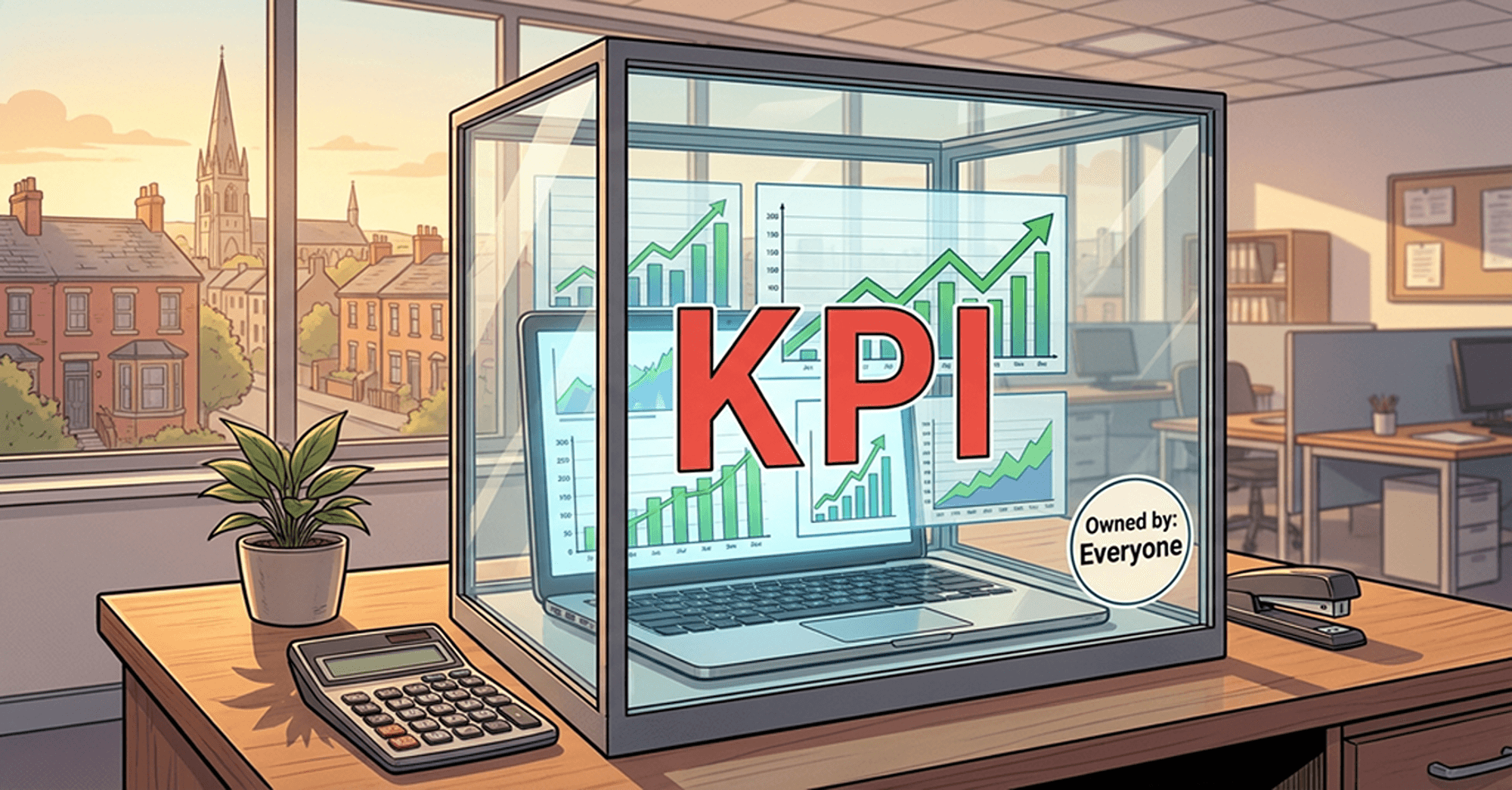
You're not missing anything. You're measuring too much.
Research: Businesses with 20+ KPIs perform worse than businesses with 5-7 KPIs.
Why: When everything is measured, nothing is prioritized. The dashboard becomes wallpaper.
What works: Five well-chosen KPIs with clear ownership outperform 25+ without ownership.
The £22M Business That Cut from 34 to 6
Starting point:
• Tracking 34 KPIs
• Weekly review: 90 minutes
• Nothing improving
New approach:
Cut to 6 KPIs with clear owners:
1. Revenue growth - CEO owns
2. Gross margin - CFO/FD owns
3. Customer acquisition cost - Marketing Director owns
4. Customer retention - CS Director owns
5. Employee retention - CPO owns
6. Cash conversion - CFO/FD owns
Result:
• Weekly review: 30 minutes
• Every metric has a name attached
• Performance jumped within 3 months
What changed: Accountability. When a metric has an owner's name, it improves.
How to Choose the Right 5-7 KPIs
Step 1: What drives business success?
For most £5M-£100M:
• Revenue growth (are we growing?)
• Margin health (profitably?)
• Customer economics (sustainably?)
• Cash position (safely?)
• Team stability (scalably?)
Step 2: ONE metric per area
Not five for sales. ONE that matters most.
Example:
• Sales: New customer acquisition (not pipeline, conversion, deal size, etc.)
• Operations: On-time delivery (not utilization, efficiency, quality, etc.)
• Finance: Cash conversion (not AR days, AP days, inventory, etc.)
Step 3: Assign clear owner
Not "sales team owns revenue" → "Sarah, Sales Director, owns new customer acquisition"
Name. One person. Accountable.
Step 4: Remove everything else from regular review
Other metrics exist. Review when needed. But weekly/monthly: Only the 5-7 with ownership.
The Five Components of Effective KPIs
For each to drive performance:
1. Clear Owner - One named person accountable
2. Regular Review - Weekly or monthly check
3. Consequences - Positive for improvement, negative for decline
4. Actionability - Owner can influence it
5. Understandability - Everyone knows what it means and why it matters
If any are missing: The metric won't drive improvement.
The Accountability Test
Can everyone name your top 5 KPIs without looking?
• YES → Right number
• NO → Too many
Can each leader name the KPI they own?
• YES → Ownership clear
• NO → Ownership unclear, won't improve
When a metric goes wrong, is one person responsible?
• YES → Accountability exists
• NO → "Everyone's responsible" = nobody
When More Metrics Help vs Hurt
More metrics HELP:
• Diagnosing a specific problem (temporary)
• Deep-dive into one area (time-limited)
• NOT part of regular review
More metrics HURT:
• Added to ongoing dashboard
• Reviewed every week/month
• "Everything is important"
• Nobody owns outcomes
Example: Cash flow tight. Temporarily track 15 cash metrics to diagnose. Fix. Return to 1-2 cash metrics in the dashboard.
Frequently Asked Questions
Why don't more KPIs improve performance?
More KPIs don't improve performance because dashboard fatigue occurs when tracking 20+ metrics - the team doesn't know what matters, everything measured means nothing is prioritized. Research shows businesses with 5-7 KPIs outperform businesses with 20+ KPIs. Performance improves from measuring the right things with clear ownership, not measuring more things. Five metrics with named owners outperforms 25 metrics with shared responsibility.
How many KPIs should a business track?
A business should track 5-7 key metrics for regular review. Each should have: one clear owner (named person accountable), regular review cadence, consequences for results, actionability by owner, team understanding. Additional metrics can exist for occasional deep-dives, but the ongoing dashboard should be 5-7 maximum. Test: Can everyone name your top 3 without looking? If no, too many.
What makes a KPI drive performance?
A KPI drives performance when it has five components: (1) Clear owner - one named person accountable, (2) Regular review - weekly or monthly check, (3) Consequences - positive for improvement, negative for decline, (4) Actionability - owner can influence it, (5) Understandability - everyone knows what it means. Without all five, the metric becomes dashboard decoration. Example: "Revenue growth - CEO owns" with weekly review drives performance. "Revenue" without an owner doesn't.
"We measure everything. 34 KPIs on a comprehensive dashboard. Nothing's improving. What are we missing?"
You're not missing anything. You're measuring too much.
Research: Businesses with 20+ KPIs perform worse than businesses with 5-7 KPIs.
Why: When everything is measured, nothing is prioritized. The dashboard becomes wallpaper.
What works: Five well-chosen KPIs with clear ownership outperform 25+ without ownership.
The £22M Business That Cut from 34 to 6
Starting point:
• Tracking 34 KPIs
• Weekly review: 90 minutes
• Nothing improving
New approach:
Cut to 6 KPIs with clear owners:
1. Revenue growth - CEO owns
2. Gross margin - CFO/FD owns
3. Customer acquisition cost - Marketing Director owns
4. Customer retention - CS Director owns
5. Employee retention - CPO owns
6. Cash conversion - CFO/FD owns
Result:
• Weekly review: 30 minutes
• Every metric has a name attached
• Performance jumped within 3 months
What changed: Accountability. When a metric has an owner's name, it improves.
How to Choose the Right 5-7 KPIs
Step 1: What drives business success?
For most £5M-£100M:
• Revenue growth (are we growing?)
• Margin health (profitably?)
• Customer economics (sustainably?)
• Cash position (safely?)
• Team stability (scalably?)
Step 2: ONE metric per area
Not five for sales. ONE that matters most.
Example:
• Sales: New customer acquisition (not pipeline, conversion, deal size, etc.)
• Operations: On-time delivery (not utilization, efficiency, quality, etc.)
• Finance: Cash conversion (not AR days, AP days, inventory, etc.)
Step 3: Assign clear owner
Not "sales team owns revenue" → "Sarah, Sales Director, owns new customer acquisition"
Name. One person. Accountable.
Step 4: Remove everything else from regular review
Other metrics exist. Review when needed. But weekly/monthly: Only the 5-7 with ownership.
The Five Components of Effective KPIs
For each to drive performance:
1. Clear Owner - One named person accountable
2. Regular Review - Weekly or monthly check
3. Consequences - Positive for improvement, negative for decline
4. Actionability - Owner can influence it
5. Understandability - Everyone knows what it means and why it matters
If any are missing: The metric won't drive improvement.
The Accountability Test
Can everyone name your top 5 KPIs without looking?
• YES → Right number
• NO → Too many
Can each leader name the KPI they own?
• YES → Ownership clear
• NO → Ownership unclear, won't improve
When a metric goes wrong, is one person responsible?
• YES → Accountability exists
• NO → "Everyone's responsible" = nobody
When More Metrics Help vs Hurt
More metrics HELP:
• Diagnosing a specific problem (temporary)
• Deep-dive into one area (time-limited)
• NOT part of regular review
More metrics HURT:
• Added to ongoing dashboard
• Reviewed every week/month
• "Everything is important"
• Nobody owns outcomes
Example: Cash flow tight. Temporarily track 15 cash metrics to diagnose. Fix. Return to 1-2 cash metrics in the dashboard.
Frequently Asked Questions
Why don't more KPIs improve performance?
More KPIs don't improve performance because dashboard fatigue occurs when tracking 20+ metrics - the team doesn't know what matters, everything measured means nothing is prioritized. Research shows businesses with 5-7 KPIs outperform businesses with 20+ KPIs. Performance improves from measuring the right things with clear ownership, not measuring more things. Five metrics with named owners outperforms 25 metrics with shared responsibility.
How many KPIs should a business track?
A business should track 5-7 key metrics for regular review. Each should have: one clear owner (named person accountable), regular review cadence, consequences for results, actionability by owner, team understanding. Additional metrics can exist for occasional deep-dives, but the ongoing dashboard should be 5-7 maximum. Test: Can everyone name your top 3 without looking? If no, too many.
What makes a KPI drive performance?
A KPI drives performance when it has five components: (1) Clear owner - one named person accountable, (2) Regular review - weekly or monthly check, (3) Consequences - positive for improvement, negative for decline, (4) Actionability - owner can influence it, (5) Understandability - everyone knows what it means. Without all five, the metric becomes dashboard decoration. Example: "Revenue growth - CEO owns" with weekly review drives performance. "Revenue" without an owner doesn't.


" height="39.65002px" id="dyBuTZHxn" transform="translate(0 1.907)" width="39.651px"/><path d="M 20.978 11.868 C 21.065 12.063 21.069 12.282 20.99 12.482 C 20.912 12.681 20.756 12.839 20.559 12.919 C 17.474 14.2 5.621 19.119 1.097 20.999 C 0.801 21.122 0.46 21.051 0.233 20.827 C 0.006 20.599 -0.062 20.257 0.06 19.962 C 1.932 15.436 6.835 3.575 8.112 0.491 C 8.193 0.291 8.352 0.134 8.55 0.054 C 8.749 -0.023 8.971 -0.018 9.167 0.068 C 14.398 2.447 18.596 6.639 20.978 11.868 Z" fill="rgb(243, 183, 3)" height="21.059159164719897px" id="j9USqGJeT" transform="translate(20.497 0)" width="21.04621552472423px"/></svg>)
The Executive
Partnership
Built to Scale. Ready to Sell.
The Executive Partnership Limited
Company No. 16340502 | Registered in England and Wales
Registered Office: Chandos House, School Lane, Buckingham, MK18 1HD, UK
The Executive
Partnership
Built to Scale. Ready to Sell.
The Executive Partnership Limited
Company No. 16340502 | Registered in England and Wales
Registered Office: Chandos House, School Lane, Buckingham, MK18 1HD, UK
The Executive Partnership
Built to Scale. Ready to Sell.
The Executive Partnership Limited
Company No. 16340502 | Registered in England and Wales
Registered Office: Chandos House, School Lane, Buckingham, MK18 1HD, UK