Why Does My Brilliant Business Sell for Less? (The Founder Genius Problem)
Finance Governance
Finance Governance
/
/
TEP
TEP
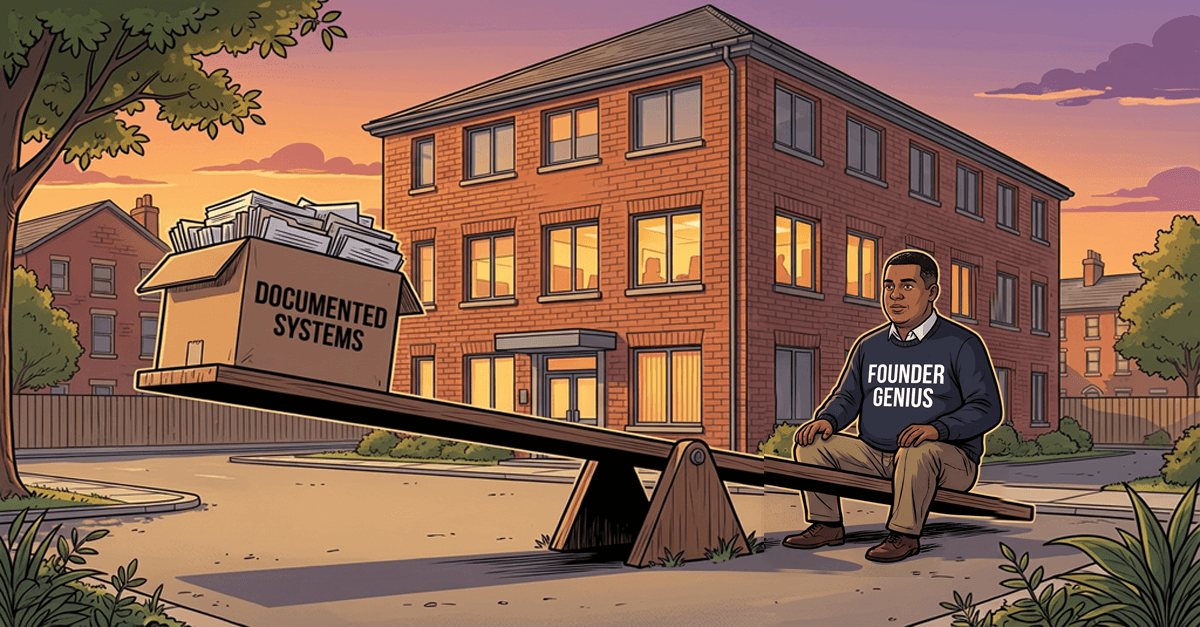
Two £25M businesses, identical EBITDA (£2.5M). Same sector, same growth.
Business A sold for £10.5M (4.2x)
Business B sold for £20.3M (8.1x)
Why the £10M difference?
Business A: Everything depended on the founder's genius
Business B: Everything ran on documented systems
How Founder Brilliance Destroys Value
The myth: "My business succeeds because of my exceptional vision, talent, decision-making."
The reality: Buyers ask "Will this work without the founder?" If it's unclear, valuation drops 30-45%.
Why buyers discount founder-dependent businesses:
• The founder's genius = unmortgageable asset
• Systematic processes = valuable asset
• Risk premium: If it depends on one person, what if they leave?
Research: Businesses built on founder brilliance sell for 4-5x EBITDA. Systematic businesses sell for 7-9x.
The Shift Required
From: "I make great decisions"
To: "We have frameworks that lead to great decisions"
Real transformation: £28M business, brilliant founder
Before systematising:
• Made all key decisions
• Key clients wanted the founder
• Buyer interest: 4.5x EBITDA
After 12 months systematizing:
• Documented decision frameworks
• Transferred client relationships
• Sale: 7.8x EBITDA
£12M higher valuation. Same business.
How to Make the Shift
Step 1: Document Decision-Making (Months 1-3)
• Map 6-8 decision types only you make
• Document: What factors? Trade-offs? Principles?
Step 2: Transfer Using Frameworks (Months 4-9)
• The team makes decisions using frameworks
• You coach reasoning
• Repeat until internalised
Step 3: Test Independence (Months 10-12)
• You step back
• The team runs for 3 months
• Prove systems work without you
Step 4: Transfer Client Relationships (Months 13-18)
• Account managers take over
• You progressively reduce involvement
• Clients comfortable with new structure
Total: 18 months to transform
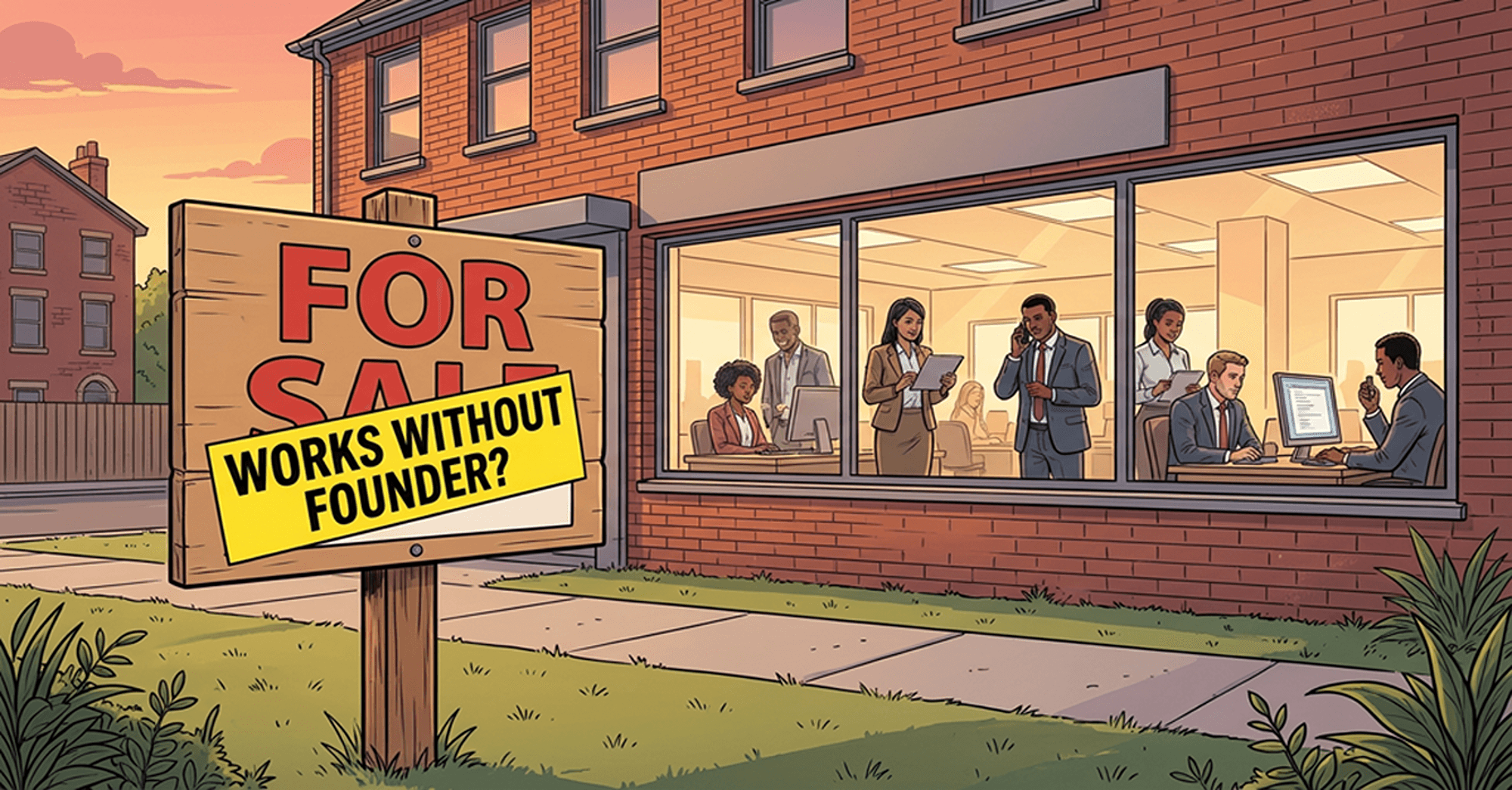
What Buyers Want to Buy
Buyers don't want:
• Your exceptional judgment
• Your relationships
• Your decision-making ability
Buyers want:
• Documented decision frameworks the team uses
• Client relationships transferred to managers
• Systems that work independently
Translation: They want a business, not rent on your genius.
When Founder Brilliance IS Valuable
Brilliance IS valuable:
• Building to £10M (drives early growth)
• Solving novel problems
• Creating a new category
Brilliance DESTROYS value:
• Preparing for exit
• Scaling beyond £10M
• Building to sell
Frequently Asked Questions
Why do founder-dependent businesses sell for less?
In the UK mid-market, EBITDA multiples commonly span 4× to 9×, with founder dependency one of the biggest drivers of value. Buyers discount businesses that cannot operate independently of the founder and pay a premium for systematised companies with transferable leadership and processes. On a £25m business, this difference in risk and repeatability can equate to several million pounds of valuation at exit.
How do I move from founder-dependent to systematized?
Move through an 18-month process: (1) Months 1-3 document decision-making frameworks, (2) Months 4-9 transfer to the team through coaching, (3) Months 10-12 test independence, (4) Months 13-18 transfer client relationships. Result: Decisions made using frameworks not founder genius, clients comfortable with the team.
What is the brilliant founder myth?
The brilliant founder myth says the business succeeds because of the founder's exceptional judgement. While this often drives early growth, M&A evidence shows that as businesses scale, founder dependency becomes a valuation risk because buyers cannot replicate individual judgement post-exit. In the UK mid-market, EBITDA multiples typically range from 4× to 9×, with founder dependency, management depth, and process maturity determining where a business lands. In practice, a 1-2× multiple difference can mean several million pounds of value on a £25m business. The shift required to protect value is from “I make great decisions” to “We have systems that consistently make great decisions.”
Two £25M businesses, identical EBITDA (£2.5M). Same sector, same growth.
Business A sold for £10.5M (4.2x)
Business B sold for £20.3M (8.1x)
Why the £10M difference?
Business A: Everything depended on the founder's genius
Business B: Everything ran on documented systems
How Founder Brilliance Destroys Value
The myth: "My business succeeds because of my exceptional vision, talent, decision-making."
The reality: Buyers ask "Will this work without the founder?" If it's unclear, valuation drops 30-45%.
Why buyers discount founder-dependent businesses:
• The founder's genius = unmortgageable asset
• Systematic processes = valuable asset
• Risk premium: If it depends on one person, what if they leave?
Research: Businesses built on founder brilliance sell for 4-5x EBITDA. Systematic businesses sell for 7-9x.
The Shift Required
From: "I make great decisions"
To: "We have frameworks that lead to great decisions"
Real transformation: £28M business, brilliant founder
Before systematising:
• Made all key decisions
• Key clients wanted the founder
• Buyer interest: 4.5x EBITDA
After 12 months systematizing:
• Documented decision frameworks
• Transferred client relationships
• Sale: 7.8x EBITDA
£12M higher valuation. Same business.
How to Make the Shift
Step 1: Document Decision-Making (Months 1-3)
• Map 6-8 decision types only you make
• Document: What factors? Trade-offs? Principles?
Step 2: Transfer Using Frameworks (Months 4-9)
• The team makes decisions using frameworks
• You coach reasoning
• Repeat until internalised
Step 3: Test Independence (Months 10-12)
• You step back
• The team runs for 3 months
• Prove systems work without you
Step 4: Transfer Client Relationships (Months 13-18)
• Account managers take over
• You progressively reduce involvement
• Clients comfortable with new structure
Total: 18 months to transform
What Buyers Want to Buy
Buyers don't want:
• Your exceptional judgment
• Your relationships
• Your decision-making ability
Buyers want:
• Documented decision frameworks the team uses
• Client relationships transferred to managers
• Systems that work independently
Translation: They want a business, not rent on your genius.
When Founder Brilliance IS Valuable
Brilliance IS valuable:
• Building to £10M (drives early growth)
• Solving novel problems
• Creating a new category
Brilliance DESTROYS value:
• Preparing for exit
• Scaling beyond £10M
• Building to sell
Frequently Asked Questions
Why do founder-dependent businesses sell for less?
In the UK mid-market, EBITDA multiples commonly span 4× to 9×, with founder dependency one of the biggest drivers of value. Buyers discount businesses that cannot operate independently of the founder and pay a premium for systematised companies with transferable leadership and processes. On a £25m business, this difference in risk and repeatability can equate to several million pounds of valuation at exit.
How do I move from founder-dependent to systematized?
Move through an 18-month process: (1) Months 1-3 document decision-making frameworks, (2) Months 4-9 transfer to the team through coaching, (3) Months 10-12 test independence, (4) Months 13-18 transfer client relationships. Result: Decisions made using frameworks not founder genius, clients comfortable with the team.
What is the brilliant founder myth?
The brilliant founder myth says the business succeeds because of the founder's exceptional judgement. While this often drives early growth, M&A evidence shows that as businesses scale, founder dependency becomes a valuation risk because buyers cannot replicate individual judgement post-exit. In the UK mid-market, EBITDA multiples typically range from 4× to 9×, with founder dependency, management depth, and process maturity determining where a business lands. In practice, a 1-2× multiple difference can mean several million pounds of value on a £25m business. The shift required to protect value is from “I make great decisions” to “We have systems that consistently make great decisions.”

Finance Governance
/
TEP
Finance Governance
/
TEP
" height="39.65002px" id="dyBuTZHxn" transform="translate(0 1.907)" width="39.651px"/><path d="M 20.978 11.868 C 21.065 12.063 21.069 12.282 20.99 12.482 C 20.912 12.681 20.756 12.839 20.559 12.919 C 17.474 14.2 5.621 19.119 1.097 20.999 C 0.801 21.122 0.46 21.051 0.233 20.827 C 0.006 20.599 -0.062 20.257 0.06 19.962 C 1.932 15.436 6.835 3.575 8.112 0.491 C 8.193 0.291 8.352 0.134 8.55 0.054 C 8.749 -0.023 8.971 -0.018 9.167 0.068 C 14.398 2.447 18.596 6.639 20.978 11.868 Z" fill="rgb(243, 183, 3)" height="21.059159164719897px" id="j9USqGJeT" transform="translate(20.497 0)" width="21.04621552472423px"/></svg>)
The Executive
Partnership
Built to Scale. Ready to Sell.
The Executive Partnership Limited
Company No. 16340502 | Registered in England and Wales
Registered Office: Chandos House, School Lane, Buckingham, MK18 1HD, UK
The Executive
Partnership
Built to Scale. Ready to Sell.
The Executive Partnership Limited
Company No. 16340502 | Registered in England and Wales
Registered Office: Chandos House, School Lane, Buckingham, MK18 1HD, UK
The Executive Partnership
Built to Scale. Ready to Sell.
The Executive Partnership Limited
Company No. 16340502 | Registered in England and Wales
Registered Office: Chandos House, School Lane, Buckingham, MK18 1HD, UK